SQL is the Structured Query Language for reading and writing database files.
The Android version of SQL is called
SQLite.
The SQLite documentation is in the form of
railroad diagrams.
For an example,
see
select.
The command line shell for SQLite is a program named
sqlite3.
It lets us type SQL commands interactively.
sqlite3
documentation on Android website (short)
sqlite3
documentation on SQLite website (long)
sqlite3
documentation on Mac OS X man pages website (shortish)
In this document,
we will begin by running
sqlite3
on the Desktop of your Mac or PC.
You can also run
sqlite3
on your Android device or emulator.
When we installed
Android Studio,
we put
sqlite3
into the directory
~/Library/Android/sdk/platform-tools,
and we put the name of this directory into our
PATH
environment
variable.
(The tilde
~
stands for the full pathname of your home directory.
For example, the full pathname of my home directory on my Mac is
/Users/mark.)
We should therefore be able to give the
sqlite3
command in our Mac terminal window or in our Windows
cmd.exe
window.
which
tells us which version of
sqlite3
would run if we went ahead and typed an
sqlite3
command.
whereis sqlite3
/usr/bin/sqlite3

sqlite3 -version
3.8.5 2014-08-15 22:37:57 c8ade949d4a2eb3bba4702a4a0e17b405e9b6ace

which sqlite3
/Users/myname/Library/Android/sdk/platform-tools/sqlite3

sqlite3 -version
3.8.10.2 2015-05-20 18:17:19 2ef4f3a5b1d1d0c4338f8243d40a2452cc1f7fe4

echo $PATH
/Users/myname/Library/Android/sdk/tools:/Users/myname/Library/Android/sdk/platform-tools:/usr/local/bin:/usr/bin:/bin:/usr/sbin:/sbin

echo $PATH | tr : '\n' | cat -n
     1	/Users/myname/Library/Android/sdk/tools
     2	/Users/myname/Library/Android/sdk/platform-tools
     3	/usr/local/bin
     4	/usr/bin
     5	/bin
     6	/usr/sbin
     7	/sbin

sqlite3 -help
Usage: sqlite3 [OPTIONS] FILENAME [SQL]
FILENAME is the name of an SQLite database. A new database is created
if the file does not previously exist.
OPTIONS include:
   -ascii               set output mode to 'ascii'
   -bail                stop after hitting an error
   -batch               force batch I/O
   -column              set output mode to 'column'
   -cmd COMMAND         run "COMMAND" before reading stdin
   -csv                 set output mode to 'csv'
   -echo                print commands before execution
   -init FILENAME       read/process named file
   -[no]header          turn headers on or off
   -help                show this message
   -html                set output mode to HTML
   -interactive         force interactive I/O
   -line                set output mode to 'line'
   -list                set output mode to 'list'
   -lookaside SIZE N    use N entries of SZ bytes for lookaside memory
   -mmap N              default mmap size set to N
   -newline SEP         set output row separator. Default: '\n'
   -nullvalue TEXT      set text string for NULL values. Default ''
   -pagecache SIZE N    use N slots of SZ bytes each for page cache memory
   -scratch SIZE N      use N slots of SZ bytes each for scratch memory
   -separator SEP       set output column separator. Default: '|'
   -stats               print memory stats before each finalize
   -version             show SQLite version
   -vfs NAME            use NAME as the default VFS
The name of our database file will be
~/Desktop/database.db.
cd ~/Desktop
pwd
ls -l

sqlite3 database.db

SQLite version 3.8.10.2 2015-05-20 18:17:19
Enter ".help" for usage hints.
sqlite> .help

.backup ?DB? FILE      Backup DB (default "main") to FILE
.bail on|off           Stop after hitting an error.  Default OFF
.binary on|off         Turn binary output on or off.  Default OFF
.clone NEWDB           Clone data into NEWDB from the existing database
.databases             List names and files of attached databases
.dbinfo ?DB?           Show status information about the database
.dump ?TABLE? ...      Dump the database in an SQL text format
                         If TABLE specified, only dump tables matching
                         LIKE pattern TABLE.
.echo on|off           Turn command echo on or off
.eqp on|off            Enable or disable automatic EXPLAIN QUERY PLAN
.exit                  Exit this program
.explain ?on|off?      Turn output mode suitable for EXPLAIN on or off.
                         With no args, it turns EXPLAIN on.
.fullschema            Show schema and the content of sqlite_stat tables
.headers on|off        Turn display of headers on or off
.help                  Show this message
.import FILE TABLE     Import data from FILE into TABLE
.indexes ?TABLE?       Show names of all indexes
                         If TABLE specified, only show indexes for tables
                         matching LIKE pattern TABLE.
.limit ?LIMIT? ?VAL?   Display or change the value of an SQLITE_LIMIT
.log FILE|off          Turn logging on or off.  FILE can be stderr/stdout
.mode MODE ?TABLE?     Set output mode where MODE is one of:
                         ascii    Columns/rows delimited by 0x1F and 0x1E
                         csv      Comma-separated values
                         column   Left-aligned columns.  (See .width)
                         html     HTML <table> code
                         insert   SQL insert statements for TABLE
                         line     One value per line
                         list     Values delimited by .separator strings
                         tabs     Tab-separated values
                         tcl      TCL list elements
.nullvalue STRING      Use STRING in place of NULL values
.once FILENAME         Output for the next SQL command only to FILENAME
.open ?FILENAME?       Close existing database and reopen FILENAME
.output ?FILENAME?     Send output to FILENAME or stdout
.print STRING...       Print literal STRING
.prompt MAIN CONTINUE  Replace the standard prompts
.quit                  Exit this program
.read FILENAME         Execute SQL in FILENAME
.restore ?DB? FILE     Restore content of DB (default "main") from FILE
.save FILE             Write in-memory database into FILE
.scanstats on|off      Turn sqlite3_stmt_scanstatus() metrics on or off
.schema ?TABLE?        Show the CREATE statements
                         If TABLE specified, only show tables matching
                         LIKE pattern TABLE.
.separator COL ?ROW?   Change the column separator and optionally the row
                         separator for both the output mode and .import
.shell CMD ARGS...     Run CMD ARGS... in a system shell
.show                  Show the current values for various settings
.stats on|off          Turn stats on or off
.system CMD ARGS...    Run CMD ARGS... in a system shell
.tables ?TABLE?        List names of tables
                         If TABLE specified, only list tables matching
                         LIKE pattern TABLE.
.timeout MS            Try opening locked tables for MS milliseconds
.timer on|off          Turn SQL timer on or off
.trace FILE|off        Output each SQL statement as it is run
.vfsname ?AUX?         Print the name of the VFS stack
.width NUM1 NUM2 ...   Set column widths for "column" mode
                         Negative values right-justify

sqlite> .databases
main: /Users/myname/Desktop/database.db
A
table
is a rectangle made of rows and columns.
The columns are things like lastname, firstname, social security number.
The
datatype
of each column could be
text,
integer (a number without a decimal point or fraction),
real (a number with a decimal point and fraction),
etc.
text
might be called
varchar
in other versions of SQL.
The rows are the records (Moe, Larry, Curly, and Shemp).
The name of our table will be
people.
Each of the commands
drop
table
and
create
table
is two separate words with a space between them.
Don’t forget the semicolon at the end of every SQL statement.
(The statements that began with a dot are not SQL statements,
and do not need a semicolon.
They are the “dot commands” listed under
Special
commands to sqlite3 (dot-commands).)
The sqlite3 continuation prompt is
…>.
Try control-p to go back to the previous line.
sqlite> drop table if exists people;

sqlite> create table people (
           lastname text,
           firstname text,
           ss integer
        );

sqlite> .tables
people

sqlite> .schema people
CREATE TABLE people (
     lastname text,
     firstname text,
     ss integer
);
select
means “print”.
sqlite> insert into people (lastname, firstname, ss) values ('Washington', 'George', 000000001);
sqlite> insert into people (lastname, firstname, ss) values ('Adams', 'John', 000000002);
sqlite> insert into people values ('Jefferson', 'Thomas', 000000003);

sqlite> select count(*) from people;
3
The
*
in the following
select
statement
means “all the fields in each selected record”.
By default,
every record in the table will be selected.
sqlite> select * from people;
Washington|George|1
Adams|John|2
Jefferson|Thomas|3

sqlite> .dump
PRAGMA foreign_keys=OFF;
BEGIN TRANSACTION;
CREATE TABLE people (
           lastname text,
           firstname text,
           ss integer
        );
INSERT INTO "people" VALUES('Washington','George',1);
INSERT INTO "people" VALUES('Adams','John',2);
INSERT INTO "people" VALUES('Jefferson','Thomas',3);
COMMIT;
I created a file named
presidents.csv
containing comma-separated values.
It actually contains the presidencies, not the presidents,
since
Grover Cleveland
appears twice.
Use your browser to save
this file onto your Mac or PC Desktop as
presidents.csv,
not
presidents.csv.txt.
Washington,George,000000001
Adams,John,000000002
Jefferson,Thomas,000000003
Madison,James,000000004
Monroe,James,000000005
Adams,John,000000006
Jackson,Andrew,000000007
Van Buren,Martin,000000008
Harrison,William,000000009
Tyler,John,000000010
Polk,James,000000011
Taylor,Zachary,000000012
Fillmore,Millard,000000013
Pierce,Franlin,000000014
Buchanan,James,000000015
Lincoln,Abraham,000000016
Johnson,Andrew,000000017
Grant,Ulysses,000000018
Hayes,Rutherford,000000019
Garfield,James,000000020
Arthur,Chester,000000021
Cleveland,Grover,000000022
Harrison,Benjamin,000000023
Cleveland,Grover,000000024
McKinley,William,000000025
Roosevelt,Theodore,000000026
Taft,William,000000027
Wilson,Woodrow,000000028
Harding,Warren,000000029
Coolidge,Calvin,000000030
Hoover,Herbert,000000031
Roosevelt,Franklin,000000032
Truman,Harry,000000033
Eisenhower,Dwight,000000034
Kennedy,John,000000035
Johnson,Lyndon,000000036
Nixon,Richard,000000037
Ford,Gerald,000000038
Carter,Jimmy,000000039
Reagan,Ronald,000000040
Bush,George,000000041
Clinton,Bill,000000042
Bush,George,000000043
Obama,Barack,000000044
Then give the following
.import
command.
sqlite> delete from people;     --every row
sqlite> select count(*) from people;
0
sqlite> .tables
people

sqlite> .mode csv
sqlite> .show
     mode: csv

sqlite> .import presidents.csv people
sqlite> select count(*) from people;
44

sqlite> .headers on
sqlite> .mode column
sqlite> .show

sqlite> select * from people;
lastname    firstname   ss
----------  ----------  ----------
Washington  George      1
Adams       John        2
Jefferson   Thomas      3
Madison     James       4
etc.

sqlite> .dump
PRAGMA foreign_keys=OFF;
BEGIN TRANSACTION;
CREATE TABLE people (
           lastname text,
           firstname text,
           ss integer
        );
INSERT INTO "people" VALUES('Washington','George',1);
INSERT INTO "people" VALUES('Adams','John',2);
INSERT INTO "people" VALUES('Jefferson','Thomas',3);
INSERT INTO "people" VALUES('Madison','James',4);
etc.
COMMIT;
sqlite> .headers on
sqlite> .mode column
sqlite> .show

sqlite> select * from people;
lastname    firstname   ss
----------  ----------  ----------
Washington  George      1
Adams       John        2
Jefferson   Thomas      3
Madison     James       4
etc.

sqlite> select ss, firstname from people;
ss          firstname
----------  ----------
1           George
2           John
3           Thomas
4           James
etc.

sqlite> select rowid, ss, firstname, lastname, firstname from people;
rowid       ss          firstname   lastname    firstname
----------  ----------  ----------  ----------  ----------
1           1           George      Washington  George
2           2           John        Adams       John
3           3           Thomas      Jefferson   Thomas
4           4           James       Madison     James
etc.
sqlite> .headers off
sqlite> .separator |
sqlite> .mode list
sqlite> .show

sqlite> select * from people;
Washington|George|1
Adams|John|2
Jefferson|Thomas|3
etc.

sqlite> select * from people where ss > 10;
Polk|James|11
Taylor|Zachary|12
Fillmore|Millard|13
etc.

sqlite> select * from people where ss % 2 = 0;
Adams|John|2
Madison|James|4
Adams|John|6
Van Buren|Martin|8
Tyler|John|10
etc.

sqlite> select * from people where ss % 2 = 1;
Washington|George|1
Jefferson|Thomas|3
Monroe|James|5
Jackson|Andrew|7
Harrison|William|9
etc.

sqlite> select * from people where firstname = 'James';
Madison|James|4
Monroe|James|5
Polk|James|11
Buchanan|James|15
Garfield|James|20

sqlite> select * from people where lastname = 'Roosevelt';
Roosevelt|Theodore|26
Roosevelt|Franklin|32
%
is a wildcard.
sqlite> select * from people where firstname like 'J%';
Adams|John|2
Madison|James|4
Monroe|James|5
etc.

sqlite> select firstname from people where firstname like '%y';
Zachary
Harry
Jimmy

sqlite> select lastname from people where lastname like '%son';
Jefferson
Madison
Jackson
Harrison
Wilson
Johnson
Multiple wildcards:
sqlite> select lastname from people where lastname like '%oo%';
Roosevelt
Coolidge
Hoover
Roosevelt

sqlite> select lastname from people where lastname like '%o%o%';
Monroe
Johnson
Roosevelt
Coolidge
Hoover
Roosevelt
Johnson

sqlite> select * from people where lastname like '% %';
Van Buren|Martin|8
Core functions, aggregate functions, date and time functions:
sqlite> select * from people where length(firstname) = length(lastname);
Lincoln|Abraham|16
Harrison|Benjamin|23

sqlite> select * from people where substr(firstname, 1, 1) = substr(lastname, 1, 1);
Wilson|Woodrow|28
Coolidge|Calvin|30
Hoover|Herbert|31
Reagan|Ronald|40

sqlite> .separator ''
sqlite> .show

sqlite> select substr(firstname, 1, 1), ". ", lastname, " (", firstname, ")" from people;
G. Washington (George)
J. Adams (John)
T. Jefferson (Thomas)
J. Madison (James)
etc.

sqlite> .separator |
sqlite> select printf("%09d", ss), firstname, lastname from people;
000000001|George|Washington
000000002|John|Adams
000000003|Thomas|Jefferson
000000004|James|Madison
desc
means “descending”.
sqlite> select * from people order by firstname;
Lincoln|Abraham|16
Jackson|Andrew|7
Johnson|Andrew|17
Obama|Barack|44
Harrison|Benjamin|23
etc.

sqlite> select * from people order by firstname desc;
Taylor|Zachary|12
Wilson|Woodrow|28
Harrison|William|9
McKinley|William|25
Taft|William|27
etc.

sqlite> select * from people where ss <= 10 order by ss desc;
Tyler|John|10
Harrison|William|9
Van Buren|Martin|8
Jackson|Andrew|7
Adams|John|6
Monroe|James|5
etc.

sqlite> select * from people order by length(lastname);
Polk|James|11
Taft|William|27
Ford|Gerald|38
Bush|George|41
Bush|George|43
Adams|John|2
etc.
Washington|George|1
Eisenhower|Dwight|34

sqlite> select * from people order by length(lastname), lastname;
Bush|George|41
Bush|George|43
Ford|Gerald|38
Polk|James|11
Taft|William|27
Adams|John|2
From each group of rows that share the same last name, print only one representative row. For example, from the group of two Roosevelts, only one will be printed. And from the group of one Washington, only one will be printed. The following statement prints 38 out of the 44 rows in the table.
sqlite> select * from people group by lastname;
Adams|John|6
Arthur|Chester|21
Buchanan|James|15
Bush|George|43
Carter|Jimmy|39
Cleveland|Grover|24
Clinton|Bill|42
Coolidge|Calvin|30
Eisenhower|Dwight|34
Fillmore|Millard|13
Ford|Gerald|38
Garfield|James|20
Grant|Ulysses|18
Harding|Warren|29
Harrison|Benjamin|23
Hayes|Rutherford|19
Hoover|Herbert|31
Jackson|Andrew|7
Jefferson|Thomas|3
Johnson|Lyndon|36
Kennedy|John|35
Lincoln|Abraham|16
Madison|James|4
McKinley|William|25
Monroe|James|5
Nixon|Richard|37
Obama|Barack|44
Pierce|Franlin|14
Polk|James|11
Reagan|Ronald|40
Roosevelt|Franklin|32
Taft|William|27
Taylor|Zachary|12
Truman|Harry|33
Tyler|John|10
Van Buren|Martin|8
Washington|George|1
Wilson|Woodrow|28
For each last name that occurs more than once, print a representative row.
sqlite> select * from people group by lastname having count(*) > 1;
Adams|John|6
Bush|George|43
Cleveland|Grover|24
Harrison|Benjamin|23
Johnson|Lyndon|36
Roosevelt|Franklin|32
For each name that occurs more than once, print a representative row. A name consists of a firstname and lastname.
sqlite> select * from people group by lastname, firstname having count(*) > 1;
Adams|John|6
Bush|George|43
Cleveland|Grover|24
For each name that occurs more than once,
print all the rows.
The above statement is in the parentheses below.
The three rows of output of the above statement
constitute the three rows of the
temporary_table
below.
sqlite> select people.lastname, people.firstname, people.ss
from people, (select * from people group by lastname, firstname having count(*) > 1) as temporary_table
where people.lastname = temporary_table.lastname and people.firstname = temporary_table.firstname;
Adams|John|2
Adams|John|6
Cleveland|Grover|22
Cleveland|Grover|24
Bush|George|41
Bush|George|43
Another way to get the same output is to join the two tables.
sqlite> select people.lastname, people.firstname, people.ss
from people join (select * from people group by lastname, firstname having count(*) > 1) as temporary_table
on people.lastname = temporary_table.lastname and people.firstname = temporary_table.firstname;
Adams|John|2
Adams|John|6
Cleveland|Grover|22
Cleveland|Grover|24
Bush|George|41
Bush|George|43
sqlite> select * from people where firstname like '%v%' and lastname like '%v%';
Cleveland|Grover|22
Cleveland|Grover|24

sqlite> select * from people where firstname like '%v%' or lastname like '%v%';
Van Buren|Martin|8
Cleveland|Grover|22
Cleveland|Grover|24
Roosevelt|Theodore|26
Coolidge|Calvin|30
Hoover|Herbert|31
Roosevelt|Franklin|32

sqlite> select * from people where not lastname like 'W%';
Adams|John|2
Jefferson|Thomas|3
Madison|James|4
etc.
sqlite> update people set firstname = 'William' where firstname = 'Bill';

sqlite> select * from people where firstname = 'William';
Harrison|William|9
McKinley|William|25
Taft|William|27
Clinton|William|42
Multiply each social security number by 10:
sqlite> update people set ss = ss * 10;

sqlite> select * from people;
Washington|George|10
Adams|John|20
Jefferson|Thomas|30
etc.
sqlite> delete from people where lastname = 'Nixon';
sqlite> select * from people;

sqlite> delete from people;     --every row
sqlite> select * from people;
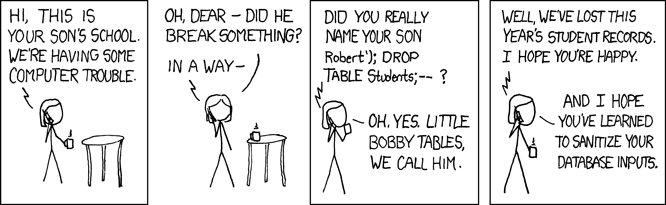
Suppose a
sinister
force
changed the above seven characters
'Nixon'
to the 27 characters
'Nixon'; delete from people
Then the computer would execute the following statements,
deleting every row in the table.
This is called an
injection attack.
sqlite> delete from people where lastname = 'Nixon'; delete from people;
After you
.exit
or
.quit
from
sqlite3,
you should see the new file
database.db
in the current directory.
It is not a humanly-readable text file.
sqlite> .exit
ls -l database.db

file database.db
database.db: SQLite 3.x database

od -c database.db | head -8
0000000    S   Q   L   i   t   e       f   o   r   m   a   t       3  \0
0000020  004  \0 001 001  \0   @          \0  \0  \0 002  \0  \0  \0 003
0000040   \0  \0  \0  \0  \0  \0  \0  \0  \0  \0  \0 001  \0  \0  \0 004
0000060   \0  \0  \0  \0  \0  \0  \0 003  \0  \0  \0 001  \0  \0  \0  \0
0000100   \0  \0  \0  \0  \0  \0  \0  \0  \0  \0  \0  \0  \0  \0  \0  \0
0000120   \0  \0  \0  \0  \0  \0  \0  \0  \0  \0  \0  \0  \0  \0  \0 002
0000140   \0   - 346 006  \r  \0  \0  \0 001 003   z  \0 003   z  \0  \0
0000160   \0  \0  \0  \0  \0  \0  \0  \0  \0  \0  \0  \0  \0  \0  \0  \0
Press the space bar to tell
more
to release the next screenful of the dump,
or
q
to quit.
sqlite3 database.db .dump | more
Use your browser to save the file
zip5.csv
onto your Mac or PC Desktop as
zip5.csv.
cd ~/Desktop
pwd

head -3 zip5.csv
00501,Holtsville,NY,40.8152,-73.0455,Suffolk
00544,Holtsville,NY,40.8152,-73.0455,Suffolk
00601,Adjuntas,PR,18.1788,-66.7516,Adjuntas

sqlite3 zipcodes.db
sqlite> create table zipcodes (
   zipcode integer,
   city text,
   state text,
   latitude real,
   longitude real,
   county text
);

sqlite> .tables
sqlite> .schema zipcodes

sqlite> .mode csv
sqlite> .import zip5.csv zipcodes
sqlite> select count(*) from zipcodes;
41755

sqlite> select * from zipcodes where zipcode = 10003;	--7 East 12th Street
10003,New York,NY,40.731253,-73.989223,New York
A degree of latitude is equal to approximately 57.2957795 miles
anywhere on the globe,
so a mile is equal to 1/57.2957795 degrees
and a half mile is a equal to .5/57.2957795 degrees.
A degree of longitude is equal to approximately .75 * 57.2957795 miles
in New York City, because the cosine of our latitude is approximately .75.
(The longitude lines are closer together than the latitude lines.)
Let’s find all the zip codes in the square mile centered on 10003.
We should have used
printf
to ensure that every zip code,
even the ones with leading zeroes,
prints out as a full five-digit number.
sqlite> select * from zipcodes
    where abs(latitude  -  40.731253) < .5 / 57.2957795
    and   abs(longitude - -73.989223) < .5 / (.75 * 57.2957795);

10003,"New York",NY,40.731253,-73.989223,"New York"
10009,"New York",NY,40.726188,-73.979591,"New York"
10010,"New York",NY,40.737476,-73.981328,"New York"
10012,"New York",NY,40.72553,-73.998284,"New York"
10159,"New York",NY,40.7389,-73.9845,"New York"
10160,"New York",NY,40.7389,-73.9845,"New York"
10211,"New York",NY,40.7314,-73.9904,"New York"
10276,"New York",NY,40.7314,-73.9904,"New York"
cd ~/Desktop
pwd
sqlite3 america.db
sqlite> create table states (
           abbreviation text primary key,
           name text,
           nickname text
        );

sqlite> .tables

sqlite> insert into states (abbreviation, name, nickname) values ('NY', 'New York', 'The Empire State');
sqlite> insert into states (abbreviation, name, nickname) values ('NJ', 'New Jersey', 'The Garden State');
sqlite> insert into states (abbreviation, name, nickname) values ('IL', 'Illinois', 'Land of Lincoln');
sqlite> select * from states;
I created the states table before the cities table because the cities table refers to the states table.
sqlite> create table cities (
           name text,
           state text
        );

sqlite> .tables

sqlite> insert into cities (name, state) values ('New York', 'NY');
sqlite> insert into cities (name, state) values ('Yonkers', 'NY');
sqlite> insert into cities (name, state) values ('Newark', 'NJ');
sqlite> insert into cities (name, state) values ('Chicago', 'IL');
sqlite> select * from cities;
sqlite> select * from cities, states;	--4 × 3 = 12 lines of output
New York|NY|NY|New York|The Empire State
New York|NY|NJ|New Jersey|The Garden State
New York|NY|IL|Illinois|Land of Lincoln
Yonkers|NY|NY|New York|The Empire State
Yonkers|NY|NJ|New Jersey|The Garden State
Yonkers|NY|IL|Illinois|Land of Lincoln
Newark|NJ|NY|New York|The Empire State
Newark|NJ|NJ|New Jersey|The Garden State
Newark|NJ|IL|Illinois|Land of Lincoln
Chicago|IL|NY|New York|The Empire State
Chicago|IL|NJ|New Jersey|The Garden State
Chicago|IL|IL|Illinois|Land of Lincoln

sqlite> select name from cities;
New York
Yonkers
Newark
Chicago

sqlite> select cities.name from cities;

sqlite> select cities.name, states.name from cities, states where cities.state = states.abbreviation;
New York|New York
Yonkers|New York
Newark|New Jersey
Chicago|Illinois

sqlite> .separator ''
sqlite> .show

sqlite> select cities.name, ', ', cities.state, ' (', states.name, '--', states.nickname, ')'
   from cities, states
   where cities.state = states.abbreviation;

New York, NY (New York--The Empire State)
Yonkers, NY (New York--The Empire State)
Newark, NJ (New Jersey--The Garden State)
Chicago, IL (Illinois--Land of Lincoln)
sqlite> .exit
ls -l america.db
file america.db
sqlite3 america.db .dump | more